
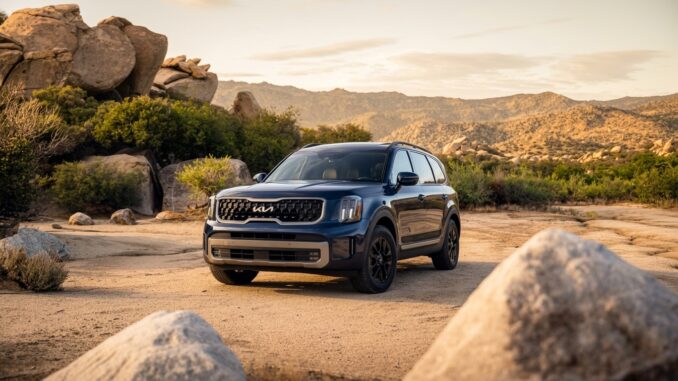
Imagine this. You buy a massive, gorgeous, three-row family hauler. The Kia Telluride. It is the undisputed darling of the automotive press. You park it in your attached garage after a long road trip, lock the doors, and head inside for a good night of sleep.
And then, at three in the morning, your smoke alarms start screaming.
Why? Because the tiny electric motor that moves your driver’s seat forward and backward decided to run forever, overheated, and sparked a fire under the cushion.
This isn’t a hypothetical horror story meant to scare you. It is the exact reason Kia and federal safety regulators just told nearly half a million Telluride owners to immediately banish their vehicles to the driveway.
We need to talk about this. We need to talk about why the cars we drive are suddenly so complicated that a piece of plastic trim can burn your house down. Let’s dive deep into the massive July 2026 Kia Telluride recall, why the automaker is demanding you park outside, and why their last attempt to fix this exact same problem was a total disaster.
Table of Contents
The July 2026 Bombshell Announcement
On a sweltering week in July 2026, the National Highway Traffic Safety Administration (NHTSA) and Kia America dropped a massive consumer alert. They issued an urgent “park outside” mandate for 462,869 Kia Telluride SUVs.
This recall covers Tellurides from the 2020 through 2024 model years. If your vehicle was built between January 9, 2019, and May 29, 2024, you are on the list.
The warning is blunt. Do not park your Telluride in your garage. Do not park it near your house. Do not park it right next to other vehicles. Leave it out in the open.
Why the sudden extreme caution? Because your power seat motor might catch fire. And the truly terrifying part is that it can happen whether the vehicle is cruising down the highway at seventy miles per hour, or parked, turned off, and locked in your driveway.
Let that sink in. Your car is off. The keys are in your kitchen. But a tiny motor under your seat is secretly churning away, building heat, melting plastic, and waiting to ignite.
What Exactly Is Happening Under Your Seat?
To understand how a seat can catch fire, we have to look at how modern car interiors are designed.
Think of your power seat like a miniature robotic forklift. You have a switch panel on the side of the seat base. When you push the slide knob forward, an electrical contact closes. Power flows from the battery to a small electric motor under the seat frame. The motor spins, turns a threaded rod, and physically drags your seat forward. When you let go of the knob, a spring pushes the switch back to the neutral position, breaking the circuit and stopping the motor.
It is a beautifully simple concept. Until human beings interact with it.
Here is the fatal flaw in the Telluride’s design. The side cover of the seat—the plastic panel holding those switches—is vulnerable. If you bump it hard with your hip when climbing out of the car, or if your kid kicks it while scrambling into the second row, that plastic cover can flex or break.
When it gets hit with excessive force, the switch inside gets dislodged. It gets knocked out of alignment.
When it misaligns, it can get permanently stuck in the “on” position.
Imagine holding your blender’s “puree” button down for six hours straight. The motor would eventually scream, smoke, and die. That is exactly what is happening under the Telluride’s seat cushion. The motor runs continuously against the physical limit of the seat track. It cannot move the seat any further, but the electricity keeps flowing. The electrical resistance builds incredible heat. Eventually, the motor gets so hot that it melts its own plastic housing, smolders, and catches the surrounding upholstery on fire.
The Ghost of Recalls Past: A Failed Fix
If you own a 2020 to 2024 Telluride, you might be reading this and thinking, “Wait a minute. Didn’t I already take a day off work to get this exact thing fixed?”
Yes. You did. And that is what makes this current situation so incredibly frustrating for consumers.
This is a repeat recall.
Back in June 2024, Kia identified this exact same fire risk. They recalled the exact same batch of vehicles. Their original fix seemed logical at the time. Dealership technicians were instructed to install a reinforcing bracket behind the power seat switch cover and replace the slide knob. The idea was to physically brace the switch so that if you bumped it with your hip, it wouldn’t dislodge.
It did not work.
Over the next two years, the fires kept happening. Between October 2024 and April 2026, Kia’s internal tracking discovered eighteen new incidents tied to this defect. We are talking about seven actual seat fires and eleven cases where the seat motors melted into a puddle of toxic plastic.
What went wrong with the 2024 fix? Kia blames “sporadic dealer workmanship issues.” In plain English, they are saying that some dealership mechanics did not install the reinforcing bracket correctly. Or perhaps the engineers underestimated the sheer twisting force a human body applies to a seat cushion when sliding out of a tall SUV.
Regardless of who is to blame, the reality is stark. The physical bracket failed to stop the fires. So now, in 2026, Kia is changing their strategy completely.
The New Fix: Treating the Symptom with Electronics
Since physically reinforcing the switch didn’t solve the problem, Kia is taking a different route. This time, they are going to cut the power.
Starting in mid-August 2026, dealerships will begin installing a specialized electronic fuse assembly directly into the seat motor wiring harness.
Here is how the new fix works. If you bump the switch and it gets stuck, the motor will still try to run. But as the motor strains against the end of the seat track, it will draw a massive spike in electrical current. The new smart fuse will detect that abnormal power draw and instantly pop, permanently cutting all electrical power to the seat motor.
The motor dies before it can get hot. The fire is prevented.
It is a clever solution. But it also means that if your switch ever fails, your power seat will be totally dead until you take it back to the dealer for a new fuse and a new switch. Still, a broken seat is vastly preferable to a burning house.
The “Park Outside” Mandate: What It Really Means for You
Let’s talk about the real-world impact of a “park outside” order.
Automakers do not issue these lightly. Admitting that your product might randomly combust in a customer’s driveway is a public relations nightmare. But the NHTSA takes fire risks incredibly seriously. When the data shows a risk of parked-car fires, the mandate is issued.
For Telluride owners, this is a massive headache.
If you live in a sprawling suburb with a massive driveway, maybe it’s just a minor inconvenience. But what if you live in a dense urban neighborhood where street parking is a daily bloodsport? What if you live in an apartment complex with a subterranean parking garage? You are being told you cannot safely park your car in the spot you pay for.
You have to leave your fifty-thousand-dollar SUV out in the summer sun, exposed to hail, bird droppings, and potential thieves. And you have to do it for weeks, if not months, while you wait for parts to arrive at your local dealership.
Kia will start mailing official notification letters to owners between August 13 and August 19, 2026. Until you get that letter, book your appointment, and have the new fuse installed, you are officially on driveway duty.
The Warning Signs: How to Spot a Melting Motor
While you are waiting for your recall appointment, you need to be hyper-vigilant.
How do you know if your seat motor is currently in a death spiral? There are three distinct warning signs you must watch out for every single time you drive your Telluride.
- The Phantom Movement. If you push the seat slide knob, let go, and the seat keeps moving for a second or two, your switch is sticking. This is the absolute earliest warning sign. If your seat does not stop the exact millisecond you release the button, you have a problem.
- The Smell of Defeat. Overheating electronics have a very specific, acrid, chemical odor. If your cabin suddenly smells like melting plastic, burning hair, or ozone, pull over immediately.
- The Smoke Screen. This is the final stage. If you see visible smoke wafting up from beneath the front driver or passenger seat, the motor is already melting. Turn off the vehicle, get everyone out, and step far away.
The Broader Industry Context: Complexity is Killing Reliability
We have to zoom out for a second. Why does this keep happening?
Kia and its corporate sibling Hyundai have recalled millions of vehicles over the past decade for various fire risks. We have seen recalls for ABS modules short-circuiting, brake fluid leaks igniting, and tow hitch wiring harnesses going up in flames.
But this isn’t just a Korean automaker problem. This is an industry-wide crisis born from our insatiable demand for complexity.
Cars are no longer mechanical machines. They are rolling data centers. As the industry pushes toward advanced AI diagnostics, software-defined vehicles, and massive dashboard screens, we are packing more miles of wiring into car cabins than ever before.
Every luxury feature we demand—massaging seats, ambient lighting, heated steering wheels—requires a switch, a module, and a power source. We are creating infinite points of failure.
In an era where auto loan rates are stubbornly high and buyers are stretching loan terms out to eighty-four months just to afford a family SUV, consumers expect perfection. When you are paying a thousand dollars a month for a Telluride, being told you can’t park it in your own garage is a bitter pill to swallow. It drives buyers to look for hybrid alternatives or older, simpler vehicles that don’t rely on twenty different computers just to move a seat back an inch.
The industry needs to take a hard look in the mirror. We are engineering vehicles to be so “smart” that a dumb piece of plastic breaking can bypass all the safety protocols and burn the car to the ground.
Dealership Drama: Getting Your SUV Fixed
So, what is the exact game plan if you own one of these 462,869 Tellurides?
First, you need to verify your status. The NHTSA has activated the VIN lookup tool for this specific recall (NHTSA Campaign Number 26V430). Grab your insurance card, find your Vehicle Identification Number, and punch it into the NHTSA website or the Kia Owners Portal.
If you are on the list, you wait for the mail. The letters drop in mid-August.
When you call your local service department, be prepared for a wait. Dealerships are about to be flooded with nearly half a million angry Telluride owners all demanding the same fuse installation at the exact same time. The logistics of supplying 462,000 wiring harnesses and fuses across North America is a nightmare.
The repair itself is entirely free. You will not pay a single dime for parts or labor.
And here is a crucial piece of information: if you already experienced a broken seat switch in the past and paid a mechanic out of your own pocket to fix it, Kia owes you money. The automaker has filed a general reimbursement plan with the federal government. If you have the receipts for a previous power seat repair, bring them to the dealership. You are legally entitled to get your cash back.
The Bottom Line: Take This Seriously
It is incredibly easy to get recall fatigue. Millions of cars are recalled every single year for things like software glitches and misprinted tire labels. It becomes white noise.
Do not treat this Telluride recall like white noise.
While the mathematical risk of your specific vehicle catching fire is relatively low—Kia estimates only about one percent of the recalled SUVs actually have the broken switch defect—the consequences are catastrophic. A car fire in an attached garage in the middle of the night is a lethal threat to your family.
Respect the “park outside” mandate. Move the car out of the garage. Keep it away from your house siding. Watch the seat switch like a hawk. And the moment those notification letters hit the mail in August, blow up your dealership’s phone lines until you secure an appointment.
The Kia Telluride is a fantastic vehicle. It just needs a little electronic supervision to make sure it doesn’t get too hot under the collar.
Frequently Asked Questions (FAQs)
1. Does this recall affect all Kia Tellurides ever made?
No. This specific recall covers 2020 through 2024 model year Tellurides built between January 9, 2019, and May 29, 2024. If your Telluride was built on or after May 30, 2024, it already has an updated, reinforced seat switch mechanism from the factory and is totally safe. Also, if you have a base model Telluride with manual front seats (meaning you use a metal bar to slide the seat), you are completely exempt because you don’t have the electrical motor that causes the fire.
2. I already got my Telluride fixed for this exact issue in 2024. Do I have to go back to the dealer again?
Yes. Absolutely. The physical bracket fix that Kia performed during the June 2024 recall (NHTSA campaign 24V407) was deemed ineffective due to workmanship issues and design limits. Even if you had that bracket installed, you must go back to the dealership to have the new electronic fuse assembly installed to truly eliminate the fire risk.
3. My power seat is already broken and makes a grinding noise. Is it safe to drive?
If your power seat switch is stuck, making continuous noise, or if you smell burning plastic, your vehicle is actively experiencing the failure. Stop driving it immediately. Park it far away from any structures or other vehicles and contact your local Kia dealership to have it towed in for immediate repair. Do not attempt to forcefully yank the switch out yourself while the battery is connected.
4. Will Kia give me a loaner car while I wait for parts to arrive?
Automakers are not federally required to provide loaner vehicles for recalls unless the vehicle is entirely undrivable. Because this is a “park outside” warning and not a “do not drive” order, you can still legally commute in your Telluride. However, many dealerships have their own internal fleets and may offer you a loaner or a rental car if the wait for the new fuse assembly is excessively long. You have to ask your specific service advisor directly.
5. Does this fire risk impact other Kia or Hyundai vehicles with the same seats?
This particular recall (NHTSA Campaign 26V430) is strictly for the Kia Telluride. However, Kia and Hyundai share many corporate parts. In fact, Kia previously recalled a small batch of 2027 Tellurides just months ago due to a different seat motor issue that mirrored a massive stop-sale order on the Hyundai Palisade. Always run your VIN through the NHTSA database to check for open campaigns on any vehicle you drive.
Leave a Reply