
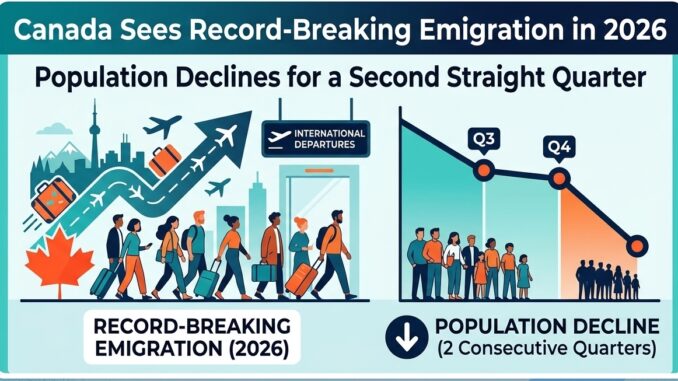
Canada is experiencing a historic demographic shift. New data released by the Government of Canada and Statistics Canada shows that emigration has reached unprecedented levels, while the country’s population has declined for the second consecutive quarter.
According to quarterly demographic estimates released by Statistics Canada on June 17, 2026, a record 30,092 Canadian citizens and permanent residents left Canada during the first quarter of 2026. This marks the highest first-quarter emigration total ever recorded.
The figures highlight a significant change in Canada’s population dynamics. While immigration continues to add new permanent residents, rising emigration, lower immigration targets, and a large reduction in temporary resident numbers are reshaping the country’s growth trajectory.
Canada Records Highest First-Quarter Emigration Ever
Statistics Canada’s latest demographic estimates reveal that 30,092 Canadian citizens and permanent residents emigrated between January 1 and April 1, 2026.
At the same time, 9,952 former emigrants returned to Canada, resulting in a net emigration figure of 20,140 people during the quarter.
The first-quarter total surpassed the previous Q1 record established in 2025 and continues a trend that has been accelerating for several years.
The data suggests that Canada’s rising emigration numbers are no longer a temporary post-pandemic phenomenon. Instead, they appear to reflect a broader and more sustained shift in migration patterns.
Canada’s Unemployment Rate Falls to 6.6% as Economy Adds 88,000 Jobs in Strong May Rebound
Canada’s Population Shrinks Again in Early 2026
Despite welcoming 83,149 new permanent residents during the quarter, Canada recorded an overall population decline of 55,025 people.
As of April 1, 2026, Canada’s estimated population stood at 41,417,056.
This follows a population decline of 103,504 people during the final quarter of 2025, making it the second consecutive quarter of population loss.
For decades, Canada relied on strong immigration levels to offset aging demographics and low birth rates. However, recent policy changes and rising outflows are creating a very different population picture.
Full-Year 2025 Emigration Set an All-Time National Record
The newly released data confirms that 2025 established the highest annual emigration total in Canadian history.
A total of 120,640 Canadians and permanent residents left the country during 2025.
That figure surpassed previous records dating back to the 1950s and exceeded totals recorded during the well-known brain drain periods of the 1960s and late 1990s.
Net emigration reached 65,706 in 2025 after accounting for returning emigrants. This also represented a new all-time high.
The scale of the increase is notable:
Annual Emigration Totals
| Year | Total Emigrants | Net Emigration |
|---|---|---|
| 2025 | 120,640 | 65,706 |
| 2024 | 118,409 | 64,452 |
| 2023 | 117,367 | 64,080 |
| 2022 | 110,172 | 58,570 |
| 2021 | 83,357 | 39,161 |
| 2020 | 60,407 | 19,235 |
Over the four-year period from 2022 through 2025, nearly 467,000 people emigrated from Canada.
Temporary Residents Are Leaving Canada at Historic Rates
While emigration among citizens and permanent residents has captured attention, the departure of temporary residents represents an even larger demographic shift.
Statistics Canada reported that only 81,380 non-permanent residents arrived during Q1 2026, while 199,259 left.
This produced a net loss of 117,879 temporary residents in just three months.
The reduction aligns with federal immigration policy objectives outlined by the Government of Canada, which aim to gradually reduce the proportion of temporary residents in the population.
Canada’s Temporary Resident Population Continues to Fall
Canada’s non-permanent resident population peaked at more than 3.1 million people in 2024.
By April 2026, that number had fallen to approximately 2.56 million.
This represents a decline of nearly 600,000 temporary residents over six quarters.
According to Immigration, Refugees and Citizenship Canada (IRCC), many work permits and study permits are expected to expire throughout 2026, contributing to continued departures.
Reduced Immigration Targets Are Reshaping Population Growth
The federal government’s current Immigration Levels Plan has introduced lower admission targets compared with previous years.
Permanent resident admissions are planned at 380,000 annually, down from earlier targets of 500,000.
At the same time, temporary resident admissions are being reduced through measures affecting international students and temporary foreign workers.
The Government of Canada has stated that these adjustments are intended to address pressures related to housing, infrastructure, healthcare, and public services.
As a result, population growth has slowed considerably compared with the rapid expansion seen between 2022 and 2024.
Which Provinces Are Growing and Which Are Losing Population?
Provincial migration data reveals significant differences across Canada.
Alberta Continues to Lead Growth
Alberta remained the country’s strongest-performing province in early 2026.
The province posted population growth of 0.2 percent during the quarter and continued attracting residents from other parts of Canada.
Strong employment opportunities in energy, technology, agriculture, and construction have helped Alberta maintain its appeal.
Ontario Continues to Experience Outflows
Ontario recorded another year of net interprovincial losses.
The province lost 14,044 residents to other provinces during 2025, although the losses were smaller than those recorded in 2024.
Housing affordability remains one of the most frequently cited concerns among residents considering relocation.
Quebec and British Columbia Also Declined
Quebec and British Columbia each recorded population declines during the first quarter of 2026.
Statistics Canada data also shows Quebec experienced increased interprovincial outflows compared with previous years.
Meanwhile, growth in several Atlantic provinces has slowed following the strong migration gains seen during the pandemic years.
Why Are More Canadians Leaving the Country?
There is no single explanation for Canada’s rising emigration numbers. Instead, several factors appear to be contributing simultaneously.
Housing Affordability Challenges
Housing remains one of the most significant concerns facing Canadians.
Although home prices have moderated in some regions, affordability remains difficult in major urban centres such as Toronto and Vancouver.
High mortgage costs and elevated rents continue to influence relocation decisions.
Cost of Living Pressures
Inflation has eased compared with previous peaks, but many households continue to face high costs for housing, food, transportation, and childcare.
For some Canadians, opportunities abroad may offer a more favourable balance between income and living expenses.
Employment Opportunities Abroad
Highly skilled workers in fields such as technology, healthcare, finance, engineering, and research often have access to international career opportunities.
Countries including the United States, Australia, and several European nations continue to attract Canadian professionals.
Increased Global Mobility
Remote and hybrid work arrangements have expanded opportunities for people to live and work outside Canada while maintaining employment with international companies.
This trend has become increasingly common since 2020.
What Does Record Emigration Mean for Canada’s Economy?
Population growth plays an important role in Canada’s economic performance.
When large numbers of residents leave, governments may face challenges related to labour supply, tax revenues, and long-term economic growth.
Labour Market Impacts
Many emigrants belong to working-age groups that contribute significantly to the labour force.
Losses in skilled occupations can make it more difficult for employers to fill positions in key sectors.
Tax Revenue Considerations
Higher-income earners typically contribute a substantial share of personal income tax revenues.
Sustained increases in emigration can affect government finances over time if departures remain elevated.
Population Aging Challenges
Canada already faces demographic pressures from an aging population.
Lower population growth may increase challenges related to workforce replacement, healthcare demand, and retirement system sustainability.
How the Federal Government Is Responding
The Government of Canada has introduced several measures intended to better align immigration levels with housing and infrastructure capacity.
According to Immigration, Refugees and Citizenship Canada, efforts continue to focus on:
Economic Immigration Priorities
Federal immigration programs increasingly prioritize workers in occupations facing labour shortages, including healthcare and skilled trades.
Provincial Nominee Programs
Provincial Nominee Program allocations have increased for 2026, giving provinces greater flexibility to select immigrants based on local labour market needs.
Retention of Skilled Workers
IRCC continues to explore pathways that encourage temporary residents with Canadian work experience to transition to permanent residence and remain in the country long term.
Will Emigration Continue Rising in 2026?
The first quarter of 2026 suggests Canada could be on pace for another record year.
If emigration continues at a similar rate throughout the remaining quarters, annual departures could once again exceed 120,000 people.
However, future outcomes will depend on economic conditions, immigration policies, labour market performance, housing affordability, and global migration trends.
Statistics Canada has noted that Q1 2026 estimates remain preliminary and may be revised as additional administrative data becomes available later in the year.
The Bigger Challenge Facing Canada
Canada’s demographic story is entering a new phase.
For years, public discussion focused largely on attracting newcomers. The latest figures suggest that retaining existing residents may become equally important.
Record emigration, slower immigration growth, and large-scale departures of temporary residents are combining to create pressures not seen in decades.
Whether this trend proves temporary or develops into a long-term demographic shift will become clearer over the next several quarters. What is already evident, however, is that Canada is experiencing one of the most significant population transitions in its modern history.
Sources: Statistics Canada demographic estimates and migration tables (17-10-0040-01, 17-10-0020-01), Immigration, Refugees and Citizenship Canada 2026–2028 Immigration Levels Plan, and Government of Canada immigration program updates.
Leave a Reply