
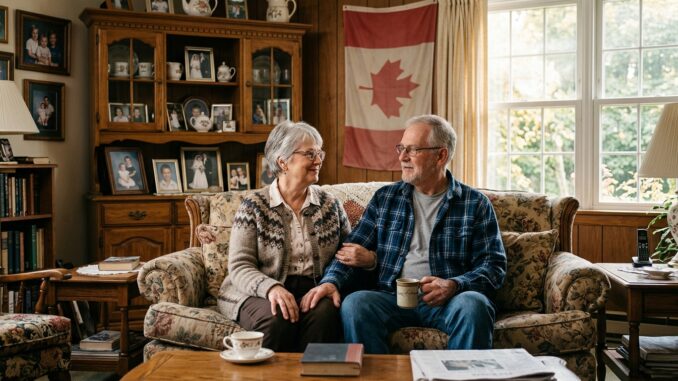
There’s a strange contradiction unfolding inside Canadian homes right now. Baby boomers are preparing to pass along an estimated $1 trillion in wealth, yet many of the dining tables, china cabinets, crystal collections and oversized furniture that filled those homes for decades are proving surprisingly difficult to give away.
That’s turning what should be a straightforward downsizing process into something far more complicated. Families aren’t just dealing with inheritances. They’re sorting through entire lifetimes of possessions, often discovering that sentimental value doesn’t necessarily translate into demand. And for many younger Canadians squeezed into condos, rental apartments and smaller homes, the issue isn’t appreciation. It’s simply a lack of space.
Table of Contents
The generation that collected everything is meeting one that wants less
Matt Cassells has watched this shift happen from inside people’s homes.
As a partner at Toronto real estate agency Walker Cassells, he frequently helps older homeowners prepare properties for sale. Before those homes ever hit the market, they often have to be emptied, cleaned and modernized, a process that can take months because of how much has accumulated over several decades.
The biggest challenge isn’t convincing homeowners to move. It’s figuring out what to do with everything they’ve collected.
According to Cassells, adult children usually keep smaller family heirlooms, artwork, jewelry and a handful of sentimental items. But the large dining room sets, china hutches and heavy furniture that once symbolized stability and success rarely fit into today’s homes or today’s decorating preferences.
That’s a theme echoed across the estate sale business.
Cory Feinstein, director of operations at Sell My Stuff Canada, says demand for traditional collectibles like fine china, crystal and figurines has fallen dramatically. Furniture, in particular, has become one of the hardest categories to sell.
Part of that comes down to changing lifestyles. Younger buyers often furnish apartments with affordable pieces from retailers like IKEA or Wayfair, replacing furniture as their needs change instead of expecting it to last a lifetime.
It’s a completely different consumer mindset from the one that shaped the baby boom generation.
New Ontario Laws August 2026 Will Quietly Change Your Wallet, Commute, and Bills Across Ontario
Why this problem is uniquely Canadian, and uniquely boomer
What stands out to me isn’t simply that tastes have changed. Every generation develops its own preferences. The bigger story is that baby boomers may have been the only generation with both the financial means and the physical space to accumulate possessions on this scale.
June Cotte, a marketing professor at Western University’s Ivey Business School, points to the postwar economic expansion as a defining factor. Baby boomers entered adulthood during decades of economic growth, expanding suburbs and rising homeownership. Larger houses naturally created more room to buy, collect and store things.
Today’s reality looks very different.
Younger Canadians are far more likely to live in smaller homes or rental apartments while facing much higher housing costs. Even those who appreciate vintage furniture often don’t have somewhere to put it.
Cotte doesn’t believe this kind of “great transfer of stuff” will repeat itself in future generations because the economic conditions that created it have changed so dramatically.
That difference becomes especially obvious after a family member dies or moves into a smaller home.
Cotte experienced it personally after her own parents passed away. She inherited the responsibility of sorting through decades of belongings, uncovering everything from Beatles and Led Zeppelin records to books, artwork, CDs, trophies and family furniture.
Some items found new homes. Her Gen Z sons happily claimed some of the vinyl records. Most of the CDs, however, had little practical value because so few people even own CD players anymore.
The furniture proved to be the hardest decision.
Some pieces had been handmade by family members, carrying enormous sentimental value. Yet neither Cotte nor her siblings had enough room to keep them.
Downsizing isn’t just about cleaning out closets
Professional organizers are seeing this play out every day.
Noreen Music, president of Professional Organizers in Canada, estimates that roughly 30% to 40% of her industry’s work now comes from helping seniors downsize or helping families sort through estates after parents pass away.
She says older Canadians often find it especially difficult to let possessions go because many grew up with memories of financial hardship or were raised by parents who did.
That history created what she describes as a scarcity mindset.
Keeping things “just in case” once made perfect sense. Throwing away useful items felt wasteful.
Younger generations, by contrast, tend to place less emotional value on physical possessions. That doesn’t necessarily mean they’re less sentimental. It simply means their memories often aren’t attached to dining room furniture or formal china sets.
When organizers step in, the goal is usually to find another home for as many items as possible.
That may involve estate sales, consignment shops, resale marketplaces or creative upcycling projects before donations become the next option. Landfill disposal is generally treated as a last resort.
Even then, getting rid of large furniture isn’t easy.
Hillary Doukas, managing director of Toronto-based estate sale company Le Grotté, says charities willing to accept bulky furniture can be surprisingly difficult to find after sales end.
And disposal isn’t free.
Municipal dump fees, junk removal services and transportation costs can quickly add hundreds of dollars to the overall expense of clearing out an estate.
Storage units are booming, but they’re not always the answer
One response has been to simply postpone the decision.
Canada’s self-storage industry continues to expand rapidly. According to commercial real estate firm Avison Young, developers added a record 2.3 million square feet of new storage space last year.
The reasons are easy to understand.
An aging population is downsizing. Housing affordability is pushing more Canadians into renting rather than owning. New apartments continue to shrink in size.
Together, those trends create steady demand for storage.
But there’s an uncomfortable reality hiding behind that solution.
Storage units can cost hundreds of dollars every month depending on location and size. Over several years, families can end up spending thousands of dollars storing possessions they’re never actually going to use.
That’s a difficult financial calculation, especially when many of the stored items continue losing resale value over time.
The secondhand market is alive, just not in the way many expected
Despite all this, it would be wrong to say younger Canadians have abandoned secondhand shopping.
They’re simply buying different things.
Twenty-six-year-old Queen’s University graduate student April McInnes told reporters that almost everything in her apartment came from Facebook Marketplace or secondhand sources.
Budget plays a huge role.
Graduate students and many young professionals often rely on used furniture, books, clothing and household goods because buying new simply costs too much.
Yet even enthusiastic thrifters have limits.
Large dining room tables designed for suburban family homes aren’t practical inside compact apartments.
Habitat for Humanity Canada’s April survey reflects that changing behavior. More than half of Canadians between 18 and 34 said they expect to thrift or purchase secondhand goods this year.
Saving money ranked as the biggest motivation, followed by the enjoyment of finding unique items and interest in do-it-yourself projects.
That’s creating opportunities for creative reuse.
Lisa Voycey, who oversees Habitat for Humanity Canada’s ReStores, has seen shoppers transform vintage sewing tables into home office desks and convert 1970s side tables into pet furniture.
Instead of preserving items exactly as previous generations used them, younger Canadians often reinvent them.
Why I think this story is really about changing values
To me, this isn’t a story about one generation rejecting another.
It’s about two completely different versions of what success looks like.
For many baby boomers, a home filled with quality furniture represented years of hard work and financial security. Those possessions weren’t just purchases. They marked milestones and memories.
For millennials and Gen Z, flexibility has become far more valuable than permanence. Renting instead of owning, moving between cities, working remotely and living in smaller spaces naturally changes what people choose to keep.
There’s another interesting point Cotte raises that deserves attention.
Many of today’s household products simply aren’t built to survive for decades the way older furniture and appliances often were. Her parents kept the same toaster for roughly 30 years. She says she’s rarely had one last more than five.
If that’s true, future generations may inherit fewer long-lasting household goods simply because fewer are being made.
The next chapter won’t be about wealth alone
Canada’s enormous intergenerational wealth transfer is already underway, but the financial assets tell only half the story.
The emotional work of deciding what deserves a place in the next generation’s lives may prove even harder than dividing estates.
Families, organizers, real estate professionals and charities are all adapting to that reality in different ways.
The next few years will likely determine whether resale markets, donation networks and creative upcycling can absorb even more of these household goods, or whether increasing amounts ultimately end up in storage facilities or landfills.
One thing seems increasingly clear: passing down wealth is relatively straightforward. Passing down an entire lifetime of possessions is proving to be much more complicated.

Leave a Reply