
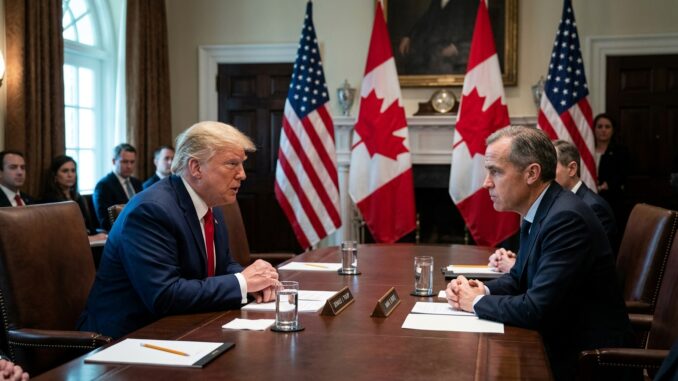
The next front in the Canada-U.S. trade fight isn’t steel, autos or lumber. This time it’s milk.
President Donald Trump’s latest tariff package puts Canadian dairy products squarely on the target list, reviving one of the oldest disputes between the two countries and reopening a debate that never really disappeared: should Canada’s supply management system remain untouchable, or has it become a bargaining chip in an increasingly unpredictable trade relationship?
For Canada’s dairy industry, the announcement wasn’t exactly a surprise. Producers have spent years expecting dairy to become a target. What they’re watching now isn’t just Washington’s next move, but Ottawa’s willingness to defend a system that thousands of farm families say underpins Canada’s food security.
Table of Contents
Why Trump is targeting Canadian dairy again
The Trump administration’s latest trade measures propose a 50 per cent tariff on a wide range of Canadian products, including milk, whey and lactose. The White House argues Canada’s dairy policies discriminate against American producers and specifically points to Canada’s supply management system as justification for the new duties, which are scheduled to take effect on August 19.
This isn’t a new complaint.
Trump has repeatedly criticized Canada’s dairy sector, arguing that import restrictions prevent American farmers from fairly accessing the Canadian market. Supply management limits production through quotas, guarantees prices for Canadian farmers and tightly controls dairy imports using tariff-rate quotas.
Canadian producers reject the idea that the system violates existing trade commitments.
The Dairy Farmers of Canada says dairy trade between the two countries is already governed by the Canada-United States-Mexico Agreement (CUSMA), an agreement Trump himself negotiated during his first administration. The organization notes that U.S. dairy exports into Canada have actually expanded significantly under that framework, climbing from C$423 million in 2019 to C$1.06 billion in 2025, a roughly 150 per cent increase.
Those numbers matter because they challenge one of the central arguments coming from Washington. If American dairy exports have grown that quickly, Canadian producers argue it’s difficult to claim the market is effectively closed.
What stands out to me is that both sides are using the same trade agreement to support completely different narratives. That’s usually a sign the disagreement isn’t only about economics anymore. It’s about leverage.
Farmers say the bigger concern is protecting supply management
At Angus MacKinnon’s dairy farm in Coaticook, Quebec, barely 10 kilometres from the U.S. border, the tariff announcement didn’t come as a shock.
Speaking to CBC News, the seventh-generation dairy farmer said he’d been expecting Trump to target Canadian dairy for nearly two years.
His reaction was surprisingly measured.
Because Canadian dairy farmers sell their milk through the supply management system at regulated prices, MacKinnon says the immediate financial hit from U.S. tariffs is unlikely to fall directly on farms. Processors and exporters could face greater pressure than producers themselves.
That doesn’t mean farmers are relaxed.
Their biggest concern is whether Canada eventually agrees to weaken supply management during future trade negotiations.
During previous negotiations, Canada expanded U.S. access to its dairy market by roughly four per cent. Many producers accepted that compromise reluctantly, believing the government had promised it would not make additional concessions later.
MacKinnon says farmers are now looking to Prime Minister Mark Carney for reassurance after the prime minister publicly pledged support for both Canadian farmers and manufacturing workers following the latest U.S. tariff threats.
For producers, that commitment matters almost as much as the tariffs themselves.
Canada has more than 9,000 dairy farms, with roughly 45 per cent located in Quebec, making dairy one of the country’s most politically sensitive agricultural industries.
The argument extends beyond farm income.
MacKinnon believes maintaining domestic milk production is ultimately about national food security. In his view, Canada shouldn’t become dependent on another country for a staple food supply, regardless of changing political relationships across the border.
The latest tariff fight comes as a wider trade battle intensifies
While dairy has captured much of the attention, it’s only one piece of a much broader trade confrontation.
Trump’s proposed tariffs cover billions of dollars in Canadian exports, from food products to manufactured goods and consumer items. Analysts have described the measures as both an economic pressure tactic and a negotiating tool aimed at strengthening the U.S. position ahead of broader trade discussions.
Prime Minister Mark Carney has already spoken with Trump following the latest announcement, with both sides agreeing to intensify trade talks as the August implementation deadline approaches.
At the same time, Canada’s premiers have also been coordinating their response as concerns grow that prolonged uncertainty could weigh on investment, manufacturing and business confidence.
Even companies not directly affected by dairy tariffs are paying attention.
Trade lawyers told The Canadian Press many Canadian exporters have adopted a wait-and-see approach after experiencing repeated tariff threats over the past year. Rather than immediately changing supply chains, many businesses are waiting to see whether the latest measures survive negotiations or are modified before taking effect.
That cautious mood probably reflects experience more than optimism. Businesses have learned that tariff announcements don’t always become permanent policy, but they still create uncertainty that affects hiring, investment and pricing decisions.
Why Wisconsin keeps coming up in this debate
One comparison frequently raised by Canadian dairy producers highlights just how different the two dairy industries are.
MacKinnon notes that Wisconsin alone produces roughly as much milk as Canada.
That difference illustrates why American and Canadian dairy sectors operate under different economic models.
The United States relies largely on open-market production with substantial scale, while Canada’s supply management framework is designed to support thousands of mostly family-operated farms by matching production more closely to domestic demand.
Critics argue that approach raises consumer prices and limits competition.
Supporters counter that it provides predictable farm incomes, avoids chronic overproduction and preserves domestic food production across rural Canada.
Neither side has fully won that argument, which explains why it resurfaces almost every time Canada and the United States renegotiate trade rules.
My take: This fight is becoming about more than milk
If there’s one lesson from the latest dispute, it’s that dairy has become a symbol rather than simply another export category.
For Washington, it’s an example of what it sees as unfair market access.
For Canada, it’s increasingly presented as a test of whether the country is prepared to defend sectors considered strategically important, even under intense political pressure.
I suspect that’s why the industry’s response has been relatively calm. Farmers know tariffs matter, but they also know the larger question is whether supply management survives the next round of trade negotiations intact.
The next few weeks could determine the tone of Canada-U.S. trade
The proposed tariffs are expected to take effect on August 19 unless negotiations change the outcome.
Between now and then, Canadian officials will continue discussions with Washington while industry groups press Ottawa to avoid further concessions on dairy.
Whether these tariffs ultimately remain in place or become another bargaining chip, one thing is already clear.
Canada’s dairy sector has once again found itself at the centre of a much larger conversation about trade, food security and the future of North America’s most important economic relationship.
Leave a Reply