
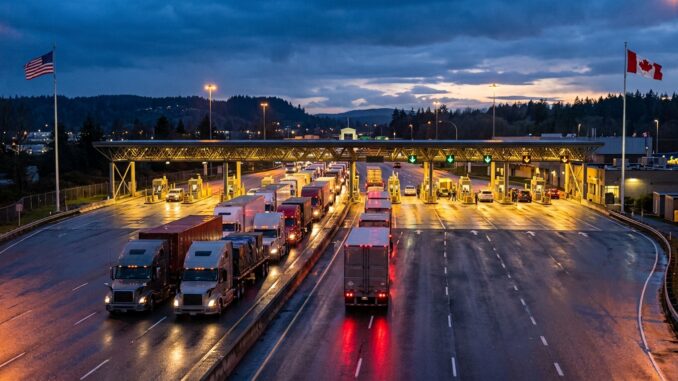
A 50% tariff is about as aggressive as it gets, and that’s exactly what President Donald Trump has chosen for a new round of duties targeting Canadian imports. The move affects roughly $20 billion worth of goods and could reopen one of North America’s biggest trade battles just as many businesses thought the worst of the tariff uncertainty was behind them.
The new Trump tariffs on Canadian goods won’t take effect immediately. Washington has set a 30-day window before they begin, leaving room for negotiations. Even so, the announcement marks one of the sharpest escalations in US-Canada trade relations in years, with Ottawa promising to defend Canadian interests and some provincial leaders already calling for an equal response.
Table of Contents
A New Tariff Strategy After the Supreme Court Limited Trump’s Options
What’s striking about this announcement isn’t only the size of the tariff. It’s the legal tool behind it.
Rather than relying on emergency powers that were curtailed earlier this year by the US Supreme Court, the Trump administration is invoking Section 338 of the Tariff Act of 1930, a law that allows tariffs of up to 50% against countries found to be discriminating against American commerce.
According to White House officials, Canada has unfairly treated US industries in three areas: automobiles, dairy products and alcoholic beverages.
Administration officials described the tariffs as defensive rather than punitive, arguing they are meant to counter Canada’s trade practices instead of starting a broader trade conflict.
That distinction may matter legally, but economically the result is the same. Canadian exporters in dozens of industries are now preparing for dramatically higher costs when selling into the United States.
What’s also noteworthy is that Section 338 has existed for decades but has rarely, if ever, been used this way. Economists at Capital Economics said the administration is effectively testing a completely different path for imposing tariffs after losing its broader emergency tariff authority in court.
If courts ultimately uphold this approach, I think it could become one of the most important trade precedents of Trump’s second term because it would give future administrations another route for imposing tariffs without declaring a national emergency.
What’s Actually Being Hit by the 50% Tariffs?
The announcement is broader than many expected, but it isn’t universal.
Several of Canada’s largest exports remain exempt, including:
- Energy products
- Potash
- Critical minerals
- Fish
- Certain goods already covered by separate industry-specific tariffs, including many metals
Instead, the White House says the new tariffs cover a wide assortment of consumer and industrial products.
Officials specifically mentioned items ranging from wine and spirits to hockey equipment and cement. Government documents released Monday also list hundreds of additional products across multiple industries.
Interestingly, despite Washington arguing that automobiles are one of the disputes driving the action, vehicles and auto parts themselves are largely absent from the new tariff lists. Existing automotive tariffs already remain in place under separate trade measures.
Another major change involves the North American trade agreement.
Unlike previous tariff rounds, products qualifying under the United States-Mexico-Canada Agreement (USMCA), known in Canada as CUSMA, will not automatically receive exemptions. That represents a meaningful shift because companies that relied on the agreement’s protections may now face duties anyway.
According to Capital Economics, only about 5% of Canadian exports to the United States would actually be affected by these specific measures, representing roughly 0.6% of total US imports. Those figures suggest the overall impact on the American economy may be relatively limited, even though certain Canadian industries could feel significant pressure.
Canada’s Response Ranges From Diplomacy to Calls for Retaliation
Canadian leaders responded quickly, although not everyone struck the same tone.
Prime Minister Mark Carney emphasized that Canada remains committed to free and fair trade while criticizing what he described as another unilateral American action that violates the USMCA.
Carney said Canada has already presented detailed proposals aimed at modernizing the agreement and is prepared to intensify negotiations over the coming weeks.
His statement also referred to broader concerns surrounding Canadian sovereignty, language many observers viewed as an indirect reference to Trump’s past remarks suggesting Canada should become America’s 51st state.
Ontario Premier Doug Ford adopted a much tougher position.
“If these tariffs proceed, Canada should respond tariff for tariff, dollar for dollar,” Ford wrote on social media, signaling support for immediate retaliation if negotiations fail.
Business groups were noticeably more cautious.
Candace Laing, president and CEO of the Canadian Chamber of Commerce, described the decision as a regrettable escalation but urged both governments to use the 30-day implementation period to make meaningful progress.
That same message was echoed south of the border.
The Distilled Spirits Council of the United States warned that new tariffs could easily trigger additional retaliation, hurting American producers that have already suffered from Canadian provincial boycotts of US alcohol.
It’s unusual when industries in both countries are simultaneously asking governments to slow down rather than speed up a trade fight. That tells you businesses on both sides recognize how interconnected these markets remain.
The Trade Disputes Behind Trump’s Decision
None of the issues cited by Washington are new.
American officials have long criticized Canada’s dairy supply management system, which limits foreign imports through quotas and imposes tariffs that can exceed 300% once those limits are reached.
Alcohol has become another major flashpoint.
Since last year, several Canadian provinces have removed many American alcoholic products from government-operated liquor stores as part of earlier retaliation against US tariffs. Washington argues those restrictions unfairly block American producers from Canada’s market.
The automotive sector adds another layer.
The Trump administration argues that Canadian tax treatment favors vehicles from countries other than the United States in certain circumstances, calling the system discriminatory toward American manufacturers.
Canada disputes that characterization.
Complicating matters further is the reality that North America’s auto industry functions as one deeply integrated manufacturing network. Parts frequently cross the US-Canada border multiple times before a finished vehicle reaches consumers.
That’s why even targeted tariffs can ripple through supply chains much more broadly than they initially appear.
The latest measures also arrive while negotiations over the future of the USMCA remain stalled.
Earlier this year, the United States declined to renew the agreement in its current form, instead pushing for changes. Although the pact continues operating through its review process, uncertainty surrounding its future has only increased.
Is This the Beginning of Another Trade War?
That may depend less on Monday’s announcement than on what happens over the next month.
Several analysts view the 30-day delay as an opportunity rather than simply a countdown.
Flavio Volpe, president of Canada’s Automotive Parts Manufacturers’ Association, urged Canadians not to panic during an interview with CBC, arguing that similar negotiating tactics emerged during Trump’s first administration before the original USMCA was finalized.
His assessment was straightforward: negotiations often become more dramatic as deadlines approach.
History offers some support for that view.
Trump has repeatedly used tariff threats as leverage in negotiations with major trading partners, including China, Mexico, Brazil and Canada.
Still, this latest move introduces fresh uncertainty because it relies on a legal authority that has not previously been tested in this way. If challenged in court, judges may eventually have to determine whether Section 338 truly grants the broad powers the administration now claims.
That legal question could ultimately prove just as significant as the tariffs themselves.
My Take: This Is Bigger Than the Products on the List
The products themselves almost feel secondary.
What stands out to me is the strategy. After losing one legal pathway for imposing broad tariffs, the White House immediately found another. That signals tariffs remain central to Trump’s economic playbook, regardless of legal setbacks.
The other takeaway is that both governments still have something to lose by allowing this dispute to spiral.
Canada depends heavily on access to the US market. At the same time, American manufacturers, retailers and consumers benefit from tightly integrated North American supply chains that have developed over decades.
Neither side can completely insulate itself from prolonged trade friction.
What Happens Next?
The immediate deadline is 30 days.
Unless negotiations produce a breakthrough, the new 50% tariffs are expected to take effect on covered Canadian imports.
In the meantime, Canadian officials are expected to continue pushing for a negotiated settlement while weighing possible retaliatory measures if Washington follows through.
Businesses on both sides of the border will also be watching closely for potential legal challenges to Section 338, since a court ruling could determine whether this becomes a one-time action or a powerful new tool for future presidents.
One thing is already clear: the US-Canada trade relationship has entered another tense chapter, and the next month may determine whether it cools back down or develops into the biggest North American trade confrontation since Trump’s first presidency.

Leave a Reply